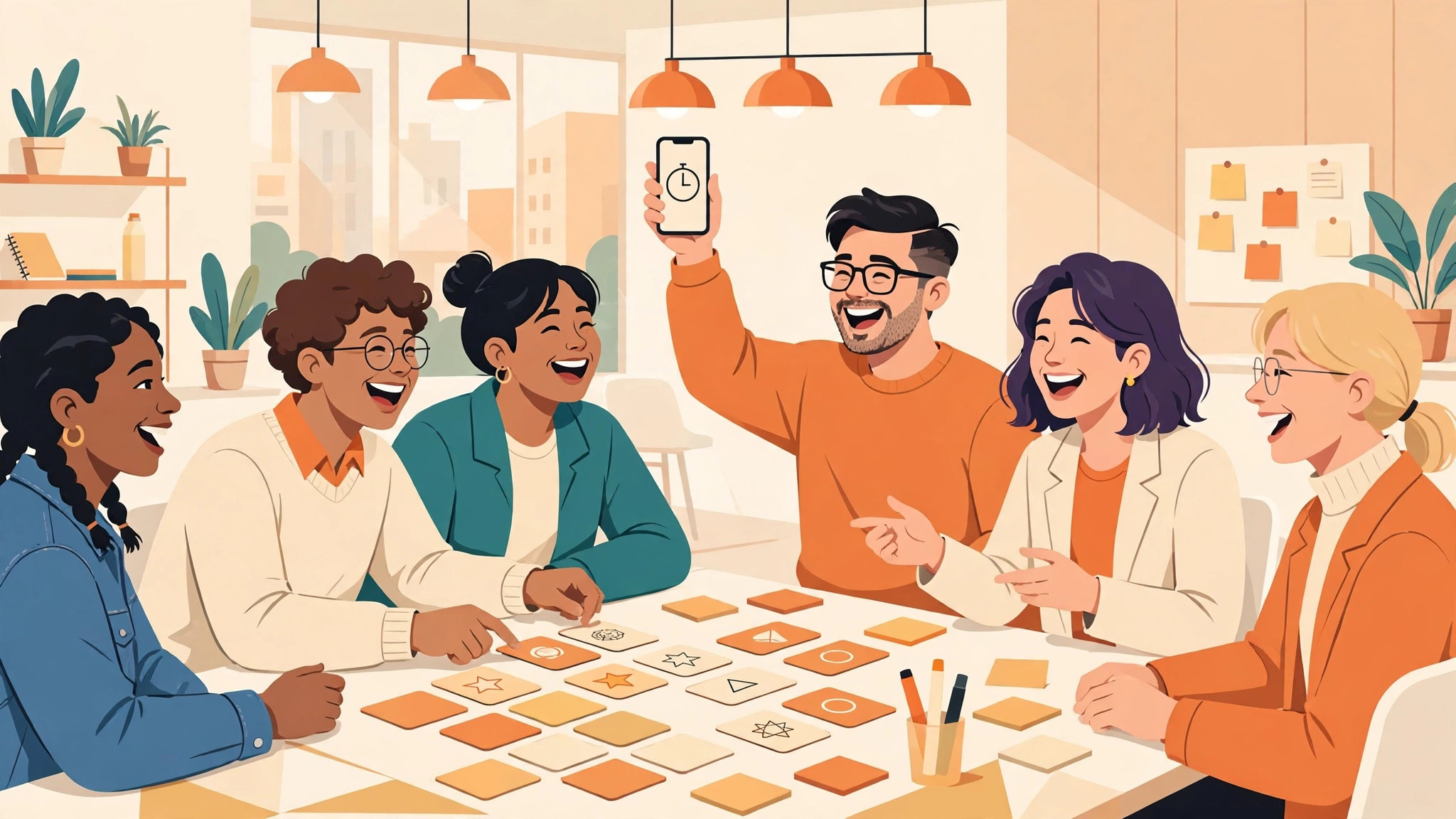
Most icebreaker games for adults fail for one reason: they were designed for children and nobody adapted them. Adults don’t want to be embarrassed — they want to laugh, learn one surprising thing about a colleague, and get on with the session.
This guide collects 15 icebreakers that actually work with adult groups — in meetings, corporate training sessions, workshops and team off-sites. Every game includes the timing, ideal group size, energy level, step-by-step instructions, a facilitator tip from real training rooms, and a debrief question that connects the game back to your session.
How to choose the right icebreaker
Match the game to the moment, not just the group:
- First 5 minutes of a meeting → pick something under 5 minutes, low embarrassment (Speed Networking, Question Ball).
- Start of a training day → pick something with a debrief link to your topic (Fastest Fingers for attention to detail, Marshmallow Challenge for collaboration).
- Post-lunch energy dip → pick something physical or competitive (Finish the Lyric, Human Bingo).
- Virtual meeting → pick something that works with cameras on and zero props (Would You Rather, Two Truths and a Lie, Guess the Desk).
Quick picker: all 15 games at a glance
| Game | Time | Group size | Energy | Best for |
|---|---|---|---|---|
| Two Truths and a Lie | 10–15 min | 5–30 | Medium | Getting to know each other |
| Human Bingo | 10–15 min | 10–50+ | High | Large groups, conferences |
| Speed Networking | 10–20 min | 8–40 | High | First meetings, workshops |
| Would You Rather (movement) | 5–10 min | 10–100+ | High | Energizer, virtual-friendly |
| Question Ball | 5–10 min | 5–25 | Low–Medium | Quiet groups, intros |
| Common Ground | 10 min | 6–30 (teams of 4–6) | Medium | New teams |
| Story Chain | 5–10 min | 5–20 | Medium | Creative sessions |
| Show and Tell (themed) | 10–20 min | 5–20 | Low–Medium | Deepening connections |
| Desert Island | 10–15 min | 5–25 | Medium | Problem-solving sessions |
| Guess the Desk | 10 min | 5–30 | Medium | Virtual teams |
| Who Am I? | 10–15 min | 6–25 | High | Fun, relaxed groups |
| The M&M Game | 5–10 min | 5–30 | Low–Medium | Casual meetups |
| Finish the Lyric | 10 min | 5–40 | High | Post-lunch energizer |
| Marshmallow Spaghetti Challenge | 20–30 min | 8–40 (teams of 4–5) | High | Collaboration training |
| Fastest Fingers 1–50 | 5 min | 1–100+ | High | Attention & focus training |
Playable right now: no setup needed
⚡ Play Fastest Fingers 1–50 — tap the numbers 1 to 50 in order as fast as you can. Runs instantly in any phone browser: share the link with the room and everyone plays simultaneously. The built-in debrief prompts (did you rush or stay controlled? what changed on your second attempt?) link straight to attention to detail, working under pressure, and continuous improvement.
The 15 games, in detail
1. Two Truths and a Lie
Time: 10–15 min · Group: 5–30 · Energy: Medium
- Each person writes down two true statements and one lie about themselves.
- One by one, players read all three aloud.
- The group discusses and votes on which statement is the lie.
- The player reveals the answer; most surprising truth wins a round of applause.
Facilitator tip: Set the tone by going first with a genuinely surprising truth — it gives everyone permission to be interesting rather than safe. Ban “I have a dog” level statements; ask for stories, not facts.
Debrief: “What assumptions did you make about people before hearing their truths?” — links to unconscious bias and first impressions.
2. Human Bingo
Time: 10–15 min · Group: 10–50+ · Energy: High
- Hand out bingo cards with traits in each square (“has run a marathon”, “speaks 3 languages”, “can juggle”).
- Players mingle, finding a different person for each square and getting them to sign it.
- First to complete a row — or the full card — shouts “Bingo!”
Facilitator tip: Tailor 4–5 squares to your organization (“has closed a deal over AED 100k”, “joined in the last 3 months”). It turns a generic game into an inside one. Print cards in advance; don’t waste session time making them.
Debrief: “Whose square surprised you most?” — links to hidden talents and diversity of experience.
3. Speed Networking
Time: 10–20 min · Group: 8–40 · Energy: High
- Arrange two lines (or inner/outer circles) facing each other.
- Give each pair 2 minutes and one question (“What’s the most useful skill you’ve learned at work?”).
- On your signal, one line shifts one place; repeat for 4–6 rounds.
Facilitator tip: Change the question every two rounds — it stops conversations going stale and the room energy stays up. Use a loud, unmistakable signal (a bell, not your voice).
Debrief: “What pattern did you notice across your conversations?” — links to listening skills and common ground.
4. Would You Rather (movement version)
Time: 5–10 min · Group: 10–100+ · Energy: High
- Read a “would you rather” question with two options.
- Players physically move to the left or right side of the room (or raise hand A/B virtually).
- Ask 2–3 volunteers from each side to defend their choice in one sentence.
Facilitator tip: Start silly (“unlimited coffee or unlimited sleep?”), then sneak in one work-flavored question (“would you rather have a brilliant plan or a brilliant team?”). The room is already moving and laughing when the meaningful one lands.
Debrief: “Did anyone change sides after hearing the arguments?” — links to persuasion and open-mindedness.
5. Question Ball
Time: 5–10 min · Group: 5–25 · Energy: Low–Medium
- Write get-to-know-you questions all over a beach ball with a marker.
- Toss it around; wherever the catcher’s right thumb lands, they answer that question.
- Keep it moving — 30 seconds per person max.
Facilitator tip: This is your game for quiet, reserved groups. The ball does the “calling on people” so you don’t have to. Keep questions light and work-safe.
Debrief: “Which answer would you steal for your own introduction?” — light, keeps the mood up.
6. Common Ground
Time: 10 min · Group: 6–30 (teams of 4–6) · Energy: Medium
- Split into small teams.
- Each team has 7 minutes to find 5 things ALL members have in common — excluding obvious ones (same company, same city).
- Teams present; the most surprising commonality wins.
Facilitator tip: The “not obvious” rule is the whole game — enforce it strictly or teams will list “we all work here” and finish in 30 seconds.
Debrief: “How deep did you have to dig before finding real common ground?” — links to team cohesion and looking past surface differences.
7. Story Chain
Time: 5–10 min · Group: 5–20 · Energy: Medium
- Start a story with one sentence (“The quarterly review was going perfectly until…”).
- Each person adds exactly one sentence.
- Go around twice; end with a one-sentence moral from a volunteer.
Facilitator tip: Give it a work-flavored opening line related to your session topic. The absurdity that follows is the point — it loosens up analytical groups fast.
Debrief: “Who built on someone else’s idea versus redirecting the story?” — links to collaboration vs. control.
8. Show and Tell (themed)
Time: 10–20 min · Group: 5–20 · Energy: Low–Medium
- A day before, ask everyone to bring (or photograph) one object matching a theme: “something that represents your hobby”, “an object older than 10 years”.
- Each person gets 60–90 seconds to show it and tell its story.
Facilitator tip: The theme matters more than the object. “Something meaningful” is too vague; “the oldest thing you own” gets great stories. Cap at 90 seconds per person or this eats your agenda.
Debrief: “What did you learn about someone that changes how you see them at work?”
9. Desert Island
Time: 10–15 min · Group: 5–25 · Energy: Medium
- One player says: “I’m going to a desert island and I’m bringing ___.”
- The items must secretly follow a category (things that come in pairs, things that are round…).
- Others guess items; the host only says “you can bring it” or “you can’t.”
- First to name the category wins and becomes the next host.
Facilitator tip: Demo one full round yourself before letting the group play, or the rules confusion kills the energy. Start with an easy category (things that are round).
Debrief: “What strategy did the winners use to crack the pattern?” — links to problem-solving and hypothesis testing.
10. Guess the Desk
Time: 10 min · Group: 5–30 · Energy: Medium
- Before the session, everyone submits a photo of their desk or workspace (no people).
- Display each photo; the group guesses whose it is.
- Reveal and let the owner share one story about one object visible.
Facilitator tip: Made for virtual teams. Ask for photos 48 hours ahead and chase stragglers — the game dies if half the photos are missing. Blur anything confidential before displaying.
Debrief: “How accurate were your guesses — and what were you basing them on?” — links to assumptions.
11. Who Am I?
Time: 10–15 min · Group: 6–25 · Energy: High
- Stick a famous person’s name on each player’s forehead (they can’t see it).
- Players mingle asking only yes/no questions to figure out who they are.
- First to guess correctly wins; keep playing until most have guessed.
Facilitator tip: Use names everyone knows across cultures in your group — mix local and global figures. Avoid anyone controversial.
Debrief: “Which questions got you closest, fastest?” — links to asking better questions.
12. The M&M Game
Time: 5–10 min · Group: 5–30 · Energy: Low–Medium
- Pass around candies; assign each color a question type (red = favorite work memory, yellow = hidden talent, green = weekend plans).
- Each person takes one candy and answers the matching question.
Facilitator tip: Any small candy or colored tokens work. This is the lowest-pressure game on this list — perfect for groups that groan at the word “icebreaker.”
Debrief: Keep it light — “Whose answer do you want to hear more about over coffee?”
13. Finish the Lyric
Time: 10 min · Group: 5–40 · Energy: High
- Play 5 seconds of a well-known song, then stop it abruptly.
- First person (or team) to correctly sing the next line scores a point.
- 8–10 rounds; winning team gets the applause.
Facilitator tip: The ultimate post-lunch energizer. Pick songs the whole room knows — mix eras and regions so no generation or culture dominates. Split into teams for bigger noise.
Debrief: “What made your team faster — knowledge or reaction speed?” — links to preparation vs. agility.
14. Marshmallow Spaghetti Challenge
Time: 20–30 min · Group: 8–40 (teams of 4–5) · Energy: High
- Each team gets 20 spaghetti sticks, 1 meter of tape, 1 meter of string, and 1 marshmallow.
- Goal: build the tallest free-standing structure with the marshmallow on top. 18 minutes.
- Measure; tallest standing structure wins.
Facilitator tip: Don’t explain strategy — the learning is in the doing. The classic finding: teams that prototype early beat teams that plan for 15 minutes. Debrief that explicitly.
Debrief: “When did your team test its first idea — minute 2 or minute 15?” — links to prototyping, planning fallacy, and collaboration under constraints.
15. Fastest Fingers 1–50
Time: 5 min · Group: 1–100+ · Energy: High
- Everyone opens the game on their phone — play it here, free, no install.
- Tap the numbers 1 to 50 in order as fast as possible; the clock starts on tap 1.
- Everyone gets two attempts; best combined improvement wins, not just the fastest time.
Facilitator tip: Scoring “most improved” instead of “fastest” keeps slower players engaged and makes the debrief ten times richer. Two attempts is non-negotiable — the second run is where the learning lives.
Debrief: “Did you rush or stay controlled? What changed on your second attempt?” — links to attention to detail, working under pressure, and continuous improvement.
Facilitator’s debrief bank
The game is the hook; the debrief is the learning. Keep these in your back pocket:
- “What did you notice about your own reaction when you made a mistake?” (resilience)
- “Did accuracy or speed win in the end?” (quality vs. quantity)
- “Who changed strategy mid-game — and why?” (adaptability)
- “What would you do differently with one more attempt?” (continuous improvement)
- “How did it feel to compete versus collaborate?” (team dynamics)
Frequently asked questions
What are the best icebreaker games for adults in meetings?
The best meeting icebreakers take under 10 minutes and need no preparation: Speed Networking, Would You Rather (movement version), Question Ball, and Two Truths and a Lie. For virtual meetings, Guess the Desk and Would You Rather work best with cameras on.
What icebreaker games work for large groups of adults?
Human Bingo, Would You Rather (movement), and the Marshmallow Spaghetti Challenge scale to 50+ people because everyone participates simultaneously — nobody waits around. Avoid turn-based games like Story Chain beyond 20 people.
Are there free icebreaker games you can play in a browser?
Yes — Fastest Fingers 1–50 runs instantly in any phone browser with no install or sign-up, making it ideal for training rooms. More playable icebreakers are being added to our games section.
How long should an icebreaker game last?
5–10 minutes for meetings, 10–20 minutes at the start of a training day, up to 30 minutes for dedicated team-building sessions. The debrief should take about a third of the total time — a 15-minute game deserves a 5-minute debrief.
How do you run icebreakers for a shy or reserved group?
Start with the lowest-exposure games: Question Ball or the M&M Game, where the prop “chooses” people rather than the facilitator calling on them. Never force participation — let observers watch one round first; most join voluntarily for round two.
What’s the difference between an icebreaker and a team-building activity?
Icebreakers are short (5–15 min), low-stakes, and designed to warm up a group at the start. Team-building activities are longer (20+ min), goal-oriented, and designed to practice collaboration — like the Marshmallow Challenge. Many games on this list work as both, depending on how you debrief them.
The bottom line
Pick one game that fits your moment, brief it in under 60 seconds, and always debrief — even for two minutes. Adults don’t remember the game; they remember what it made them notice about themselves and each other. Start with Fastest Fingers if you want zero setup, or browse all our free icebreaker games.